How Smart Med Spa Owners Are Using Automation to Turn Cancellations Into Revenue — And Why It’s Working

Hands typing on laptop displaying colorful analytics dashboard with charts and retention metrics.
Every successful business eventually hits the same wall. Not a lack of clients. Not a lack of talent. A lack of time — specifically, the time it takes to manually manage every operational detail that keeps a practice running smoothly while simultaneously trying to grow it.
That’s where automation changes everything.
The businesses that scale well aren’t necessarily working harder than the ones that plateau. They’re working differently. They’ve identified the repetitive, time-sensitive tasks that drain their team’s energy and replaced them with systems that handle those tasks faster, more consistently, and without anyone having to remember to do them. Payroll automation. Inventory management. Email sequences. Appointment reminders. The list is long — and every item on it represents hours returned to the people who should be focused on higher-value work.
Med spas are no different. In fact, for a business built around delivering premium client experiences while managing complex clinical schedules, the case for operational automation is stronger than almost anywhere else.
And in 2026, one specific automation is quietly separating the med spa owners who feel in control of their revenue from the ones who dread Monday morning cancellation stacks. It doesn’t require a tech background, a marketing team, or hours of setup. It just requires understanding that the most expensive operational problem in your practice — last-minute cancellations — doesn’t have to be a manual problem anymore.
Real-time social media automation is what that solution looks like. And the practices using it are recovering revenue that most owners have simply accepted as gone.
The Cancellation Crisis Costing Med Spas $134,000 Every Year

Med spa professional stressed at her desk over cancellations, covering her eyes with her hands.
No-show and last-minute cancellation rates across the med spa and aesthetic clinic sector currently run between 17 and 22 percent of total appointments in 2026. In a fully booked practice, that’s nearly one in five slots evaporating every week. Each missed appointment represents $200 to $500 in unrecovered revenue, depending on the treatment — a missed Botox session looks different from a missed CO2 laser appointment, but neither is free.
What makes this particularly frustrating is that most practice owners are already doing the right things. They’re sending reminders. They’re maintaining waitlists. They’re following up manually when cancellations hit. And reminder systems genuinely help — appointment reminders have been shown to reduce no-show rates by 40 to 50 percent when implemented consistently.
But here’s the gap that never gets addressed directly: reminders prevent future no-shows. They do nothing for the slot that just opened up at 11 AM today because a client cancelled this morning. That’s a different problem — and it requires a different solution entirely.
The usual way of handling a same-day cancellation often looks like this: someone spots an open slot, crams in a few quick calls between other tasks, fires off a text to a handful of randomly selected patients, and hopes for the best. It feels efficient in the moment — but the reality is far less promising. More often than not, that appointment stays unfilled. Not because the practice didn’t put in the effort, but because trying to recover a last-minute opening through manual outreach is like standing in a packed auditorium and yelling, hoping the right person hears you. The odds just aren’t on your side.
With real-time social media automation, filling that open slot becomes a lot easier and doesn’t require the practice to put in any extra work.
How Automation Can Help Medical Spas Scale in 2026
Automation in the med spa context isn’t about replacing the human elements that make a practice exceptional — the relationships, the clinical expertise, the client experience. It’s about removing the manual bottlenecks that slow down revenue recovery and drain time from people who should be focused on patients, not administrative scrambling.

Person in striped sweater using a smartphone, wearing an analog wristwatch.
Here’s what real-time social media automation actually changes for a growing med spa:
Speed. The window for filling a same-day cancellation is two to four hours at most. A manual recovery process — someone noticing the cancellation, finding time between other tasks, crafting a message, reaching out — routinely misses that window entirely. An automated system that activates within 60 seconds of a cancellation captures it every time.
Consistency. Manual outreach happens when someone remembers and has time. Automated outreach happens every single time — regardless of how busy the day is, how many cancellations hit simultaneously, or whether the front desk is managing five other things at once.
Scale. A practice with one provider and a practice with ten providers face the same cancellation recovery challenge — but at very different volumes. Automation scales with the practice without requiring additional staff time proportional to the volume.
Brand quality. A hastily assembled manual post or a generic text doesn’t reflect the premium positioning of a med spa brand. Automated, professionally branded content maintains visual consistency regardless of the time pressure involved.
The U.S. med spa market is valued at $23 to $26 billion in 2026. Practices using automation to manage cancellation recovery aren’t just recovering more revenue — they’re building the operational infrastructure that scales with market growth without proportionally scaling overhead.
How Does AI Help With Scheduling?
AI-assisted scheduling is one of the more genuinely transformative developments in med spa operations over the past two years — and its impact on cancellation management specifically is significant.
Traditional scheduling systems are reactive. They record bookings, send automated reminders, and flag openings when cancellations occur. AI-assisted scheduling adds a predictive layer — analyzing historical booking patterns, cancellation rates by provider, treatment type, day of week, and client history to anticipate where scheduling gaps are likely to occur before they happen.
For cancellation management, this means:
Predictive overbooking. Based on historical cancellation rates for specific appointment types, AI can help inform smarter scheduling decisions — booking slightly above capacity for high-cancellation time slots to account for expected attrition without over-scheduling.
Dynamic waitlist prioritization. Rather than a static waitlist, AI-assisted systems can match open slots with the clients most likely to accept a same-day or next-day appointment based on past behavior, location, availability patterns, and treatment history.
Cancellation pattern identification. Identifying which clients, treatment types, or time slots have the highest cancellation rates allows practices to make proactive policy decisions — adjusted deposit requirements, modified reminder sequencing, or targeted retention strategies for high-risk booking segments.
AI doesn’t replace the judgment of an experienced practice manager. What it does is give that manager better, faster information — and remove the manual analysis burden that nobody in a busy practice actually has time for.
How AI Is Changing the Future of Appointment Scheduling
The evolution from manual scheduling to AI-assisted scheduling to fully automated real-time social media recovery systems represents one of the most meaningful operational shifts in the aesthetic industry in 2026.
What’s changing isn’t just the speed of scheduling — it’s the entire philosophy of how practices think about appointment slots. In the traditional model, a cancellation is a loss. In the automated model, a cancellation is an immediate recovery opportunity — a trigger that activates a system designed to convert that open slot back into revenue before the day is over.
The practices that have adopted this philosophy consistently report not just higher fill rates on cancellations — 35 to 50 percent versus the 4 to 5 percent industry average for manual outreach — but meaningful changes in how their teams operate. Less administrative scrambling. Less revenue anxiety when cancellations stack up on a Tuesday morning. More confidence that the practice has systems working on its behalf, even when the team is focused elsewhere.
The future of appointment scheduling in aesthetic medicine isn’t a better waitlist or a smarter text message. It’s a fully integrated recovery system that connects booking platforms, real-time social media automation, and client communication — automatically, instantly, and consistently.
What Is the Best Approach to Handling Patient Cancellations?
The most effective cancellation management approach in 2026 operates on three layers — and most practices are only running one or two of them.
Layer 1 — Prevention. Automated reminder sequences, deposit requirements, and clear cancellation policies reduce the frequency of cancellations. Reminders cut no-show rates by 40 to 50 percent when properly sequenced — 48-hour, 24-hour, and same-day reminders each serve different behavioral functions and work best in combination.
Layer 2 — Recovery. When prevention fails — and it will, at a 17 to 22 percent rate regardless of how good the prevention layer is — the recovery system determines how much of that lost revenue gets recaptured. Manual outreach produces 4 to 5 percent fill rates. Automated real-time social media outreach produces 35 to 50 percent.
Layer 3 — Analysis. Monthly review of cancellation patterns — by provider, treatment type, day of week, and lead time — informs continuous improvement of layers one and two. Which time slots have the highest cancellation rates? Which clients are habitual cancellers? Data answers these questions. Without systematic analysis, practices optimize blindly.
AI Patient Scheduling: 2026 Guide to No-Shows, SMS, and ROI
Let’s talk return on investment — because the ROI case for automated cancellation recovery is one of the clearest in med spa operations.
The performance gap in numbers:
| Channel | Average Fill Rate | Revenue Recovered Per Cancellation | Staff Time Required |
| Manual SMS outreach | 4–5% | $10–$25 | 15–20 minutes |
| Email blast | 3–4% | $8–$20 | 10–15 minutes |
| Instagram/TikTok Stories (manual) | 15–20% | $30–$100 | 30–45 minutes |
| Real-time social media automation | 35–50% | $70–$250 | 0 minutes |
The numbers tell a clear story. Real-time social media automation doesn’t just outperform traditional channels on fill rate — it does so while eliminating the staff time cost entirely.
Instagram and TikTok Stories generate two to three times the engagement of SMS and email in the aesthetic and wellness category. The format’s built-in urgency mechanic — disappearing content, visual brand quality, immediate booking integration — drives immediate action in a way that a text notification in a crowded inbox simply cannot replicate.
The compliance reality. FDA and FTC scrutiny on aesthetic marketing claims has intensified significantly in 2026. Social media content referencing treatments, outcomes, or efficacy claims must meet compliance standards — and content created manually under time pressure is where compliance failures most commonly occur. Automated systems with compliance-built captions eliminate this risk entirely by design.
The annual ROI reality. A practice losing $6,000 monthly to cancellations and recovering 40 percent through automated real-time social media outreach is recovering $2,400 per month — $28,800 annually — from a system requiring zero additional staff time.
FDA/FTC Disclaimer: All social media content referencing aesthetic treatments should comply with FTC endorsement guidelines and applicable FDA regulations on treatment promotion. Claims regarding outcomes, efficacy, or results must be qualified and substantiated. Consult with a qualified healthcare attorney regarding compliance requirements specific to your practice and jurisdiction.
How Does SpotFill Turn Last-Minute Cancellations Into Booked Appointments?
SpotFill was built around a single operational truth: the practices losing the most revenue to cancellations aren’t losing it because they don’t care. They’re losing it because the tools available to them weren’t designed for the speed and consistency that real-time cancellation recovery actually requires.
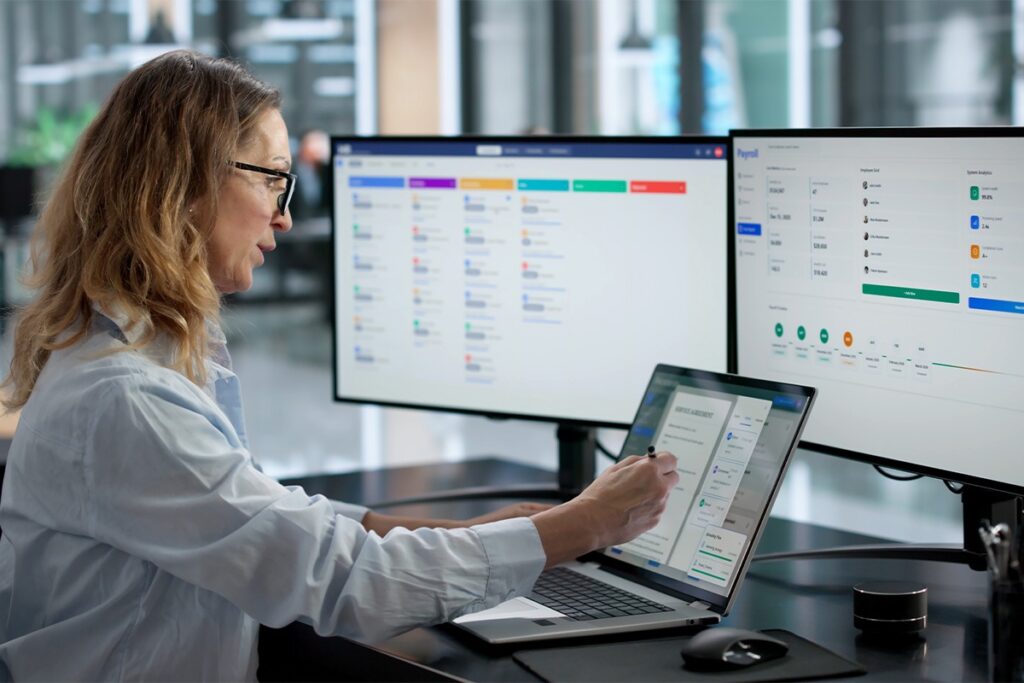
Med spa professional reviewing payroll and patient appointment data across multiple screens.
When a cancellation registers in Mindbody, Square, or Vagaro, SpotFill automatically generates two professionally branded Story slides optimized for Instagram, TikTok, and Facebook — and delivers them to the practice owner’s phone and email within 60 seconds. Every caption is FDA/FTC compliant by design. Zero design work. Zero manual effort. Complete brand consistency every time a slot opens.
Practices using SpotFill are achieving 35 to 50 percent fill rates on last-minute cancellations — compared to the 4 to 5 percent industry average for SMS and email outreach. Revenue that was being written off as the unavoidable cost of running an appointment-based business is being recovered, automatically, before the slot has time to go cold.
For busy med spa owners managing full clinical schedules, leading teams, and maintaining the client experience that justifies premium pricing, SpotFill’s real-time social media automation removes the one operational problem that was costing them six figures a year without requiring a single additional hour of their time.
Here’s what a real recovery looks like in practice: a cancellation hits at 9:47 AM. By 9:48 AM, a professionally branded Story is live on Instagram and TikTok. By 10:15 AM, the slot is filled. No design work. No manual outreach. No revenue lost.
FDA/FTC Disclaimer
This blog is for informational and educational purposes only. Statistics referenced reflect industry estimates and may vary by practice type, size, and location. All social media marketing content for aesthetic practices should comply with applicable FDA and FTC regulations. Consult a qualified healthcare attorney regarding compliance obligations specific to your practice.