






The $23 Billion Market Is Being Won Digitally. Here Is How the Best Clinics Are Claiming Their Share
Modern medical spa reception area with minimalist design, wood accents, and beauty portraits on the wall.
The best injector in your city might be completely invisible on Google.
Not because their work is anything less than exceptional. Not because their patients are anything less than loyal. But because clinical excellence and digital authority are earned in entirely different arenas — and most aesthetic practitioners have spent a decade mastering one while the other quietly determines whether a new patient ever finds them at all.
This is the uncomfortable truth at the center of local SEO for aesthetic clinics in 2026: the quality of your work inside the treatment room has almost no bearing on where Google ranks you outside of it. A practice with a less experienced injector, a more aggressive content strategy, and a meticulously maintained Google Business Profile will appear above you every single time — and the patient who would have been yours will never know the difference.
The US med spa market sits at $23–$26 billion this year. The competition for the patient who has already decided they want treatment, already decided they want a premium experience, and is right now letting Google decide who deserves their trust — that competition is not clinical. It is digital. And it is being won by the practices that understand something most of their competitors do not: that Google, in 2026, is not ranking websites. It is ranking trust.
This is what building that trust looks like — strategically, compliantly, and at a standard worthy of the brand you have spent years creating.
Compliance note: All digital marketing for aesthetic treatments must adhere to FDA guidelines governing medical device and drug advertising, and FTC regulations requiring truthful, non-deceptive claims. Language asserting guaranteed outcomes, permanent results, or unsubstantiated superiority is non-compliant. “Individual results may vary” disclaimers are required wherever treatment outcomes are referenced.
What SEO Actually Means for Aesthetic Clinics in 2026
The practices still treating SEO as a technical exercise — keyword density, meta tags, backlink counts — are optimizing for an algorithm that no longer exists. Google’s 2026 ranking infrastructure is built around one central question: does this content come from a source that genuinely knows what it’s talking about, and can patients trust it with decisions about their health and appearance?

Digital SEO dashboard showing search rankings, ratings, and analytics data on a laptop screen.
This is the E-E-A-T framework — Experience, Expertise, Authoritativeness, and Trustworthiness — and in the aesthetics space, Google enforces it with particular rigor. Medical aesthetics falls squarely into Google’s YMYL (Your Money or Your Life) content category, which means every page on your website is evaluated against the highest possible standard of credibility. A blog post written by a nameless content writer with no clinical attribution will not rank against content authored by a board-certified injector with verifiable credentials and a consistent publication history.
Simultaneously, the rise of AI-powered search — Google’s Search Generative Experience, AI Overviews, and conversational query interpretation — has fundamentally altered how patients discover aesthetic providers. An increasing proportion of local searches now resolve without a click, answered directly in the Map Pack or a featured snippet. This makes your Google Business Profile not a supplement to your SEO strategy, but the frontline of it. And it makes the specific language of your content — whether it mirrors the conversational, nuanced way patients actually search — the difference between appearing in an AI-generated answer and being invisible to it.
The clinics winning local search in 2026 are not outspending their competitors. They are out-thinking them.
The Google Business Profile: Your Most Underutilized Asset
If you have not treated your Google Business Profile as a living, strategic asset — updated weekly, photographed professionally, and populated with the same care as your website — you are leaving your most powerful local SEO lever largely unpulled.
A fully optimized GBP in 2026 functions as a standalone brand presence within Google’s ecosystem. Category selection is not a formality; choosing “Medical Spa” as your primary category, with “Skin Care Clinic” and relevant secondary categories, directly determines which high-intent queries trigger your profile. Your service menu — each entry keyword-rich, clinically accurate, and compliantly written — is indexable content that Google reads as evidence of your expertise and local relevance.
Photography matters more than most clinics realize. Practices with 100 or more high-quality images in their GBP receive more meaningful direction requests and website visits than those with a handful of stock-adjacent photos. Your space, your team, your equipment, your culture — documented with the same visual standard you apply to your patient-facing brand — signals to both Google’s algorithm and prospective patients that this is a practice that takes every detail seriously.
Weekly GBP posts, proactive Q&A management, and a consistent review generation process complete the picture. On reviews specifically, Google’s local ranking algorithm weighs not just the volume and rating of your reviews, but how recently they were left and how actively you respond to them. A practice with 200 reviews and a 4.2 rating that responds thoughtfully to every piece of feedback will frequently outrank a practice with 50 reviews and a 4.9 rating that never engages. Reviews are not a reputation metric. They are a ranking signal — and a conversion tool.
HIPAA reminder: Automated post-appointment review requests must not reference specific treatments or procedures. Request the review; let the patient choose what to share.
Google Is Reading Your Website the Way a Nervous Patient Would
Here is the reframe that changes how most aesthetic clinics think about their content: Google does not rank pages. It ranks answers — and the question it is always trying to answer, on behalf of the patient conducting the search, is “can I trust this practice with something as personal as my face?”

Woman at home researching aesthetic clinic services on her smartphone.
Most aesthetic clinic websites fail that question without realizing it. They are written for a search engine that no longer exists — stuffed with keywords, light on clinical depth, and structured around what the practice wants to say rather than what the prospective patient desperately needs to hear. A patient searching “natural-looking lip filler [city]” is not just looking for a provider. She is looking for evidence that someone at this clinic genuinely understands the difference between a result that looks refined and one that does not — and can explain it to her before she books.
That is the standard your content needs to meet in 2026. And it is why every high-revenue treatment deserves its own dedicated page — not a paragraph in a catch-all Services section, but a fully realized, practitioner-attributed resource that treats the prospective patient’s anxiety as the starting point, not an afterthought.
A genuinely high-performing Botox page, for example, does not lead with what Botox is. It leads with what the patient is afraid of — looking frozen, looking overdone, choosing the wrong provider — and then dismantles that fear with clinical specificity, transparent pricing signals, and the kind of provider credentialing that makes Google’s quality evaluators and anxious first-timers reach the same conclusion simultaneously: this practice knows what it’s doing.
This is what E-E-A-T looks like when it is working. Not a credentials badge in a sidebar, but expertise woven into every paragraph in a way that could only have come from someone who has actually stood at a treatment table and had this conversation hundreds of times. (Compliant before-and-after references, where used, must include appropriate disclaimers: “Individual results may vary.”)
A clinic offering ten treatments has ten opportunities to appear on page one — and ten opportunities to be the most reassuring, most credible answer Google can give a patient who is ready to book but not yet ready to trust. Most clinics are capturing one or two of those opportunities. The ones capturing eight or nine are not working harder. They are simply writing for the patient first and letting the algorithm follow. For practices ready to build this kind of content architecture systematically, our aesthetic SEO content packages are designed around exactly this approach.
How Med Spas Rank on Google for Botox and Fillers: The Trust Infrastructure
In the medical aesthetics space, trust is the product — and Google ranks accordingly. The practices that dominate local search have, deliberately or otherwise, built a trust infrastructure across every platform where patients look before they book.
Citation consistency is foundational: your name, address, and phone number must be identical across Yelp, Healthgrades, RealSelf, Zocdoc, and every directory where your practice appears. Discrepancies — even minor ones, like “Suite” versus “Ste” — create conflicting signals that erode Google’s confidence in your business data and suppress local rankings. This is an easy fix that reliably moves the needle.
RealSelf deserves particular attention. As a domain with extraordinary authority in the aesthetics vertical, a well-maintained RealSelf profile — with verified credentials, answered patient questions, and a consistent review presence — generates both high-quality backlinks and qualified referral traffic that no amount of on-site optimization can replicate.
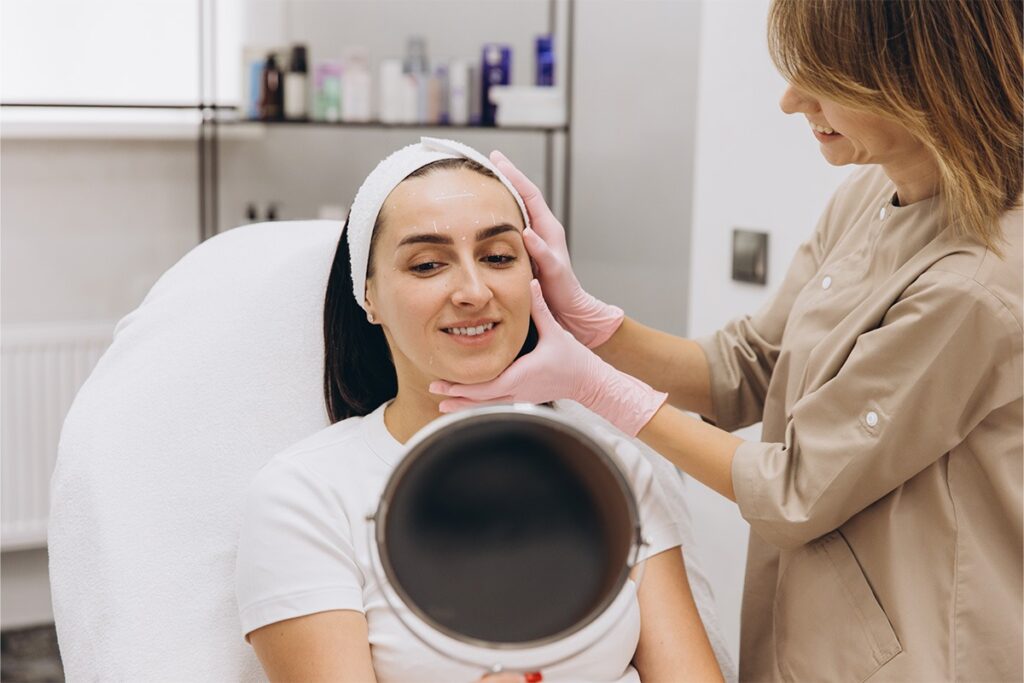
Licensed aesthetician in pink gloves examining smiling client’s skin; client looks in mirror.
Provider credentialing woven into your website content — not buried in a footnote, but foregrounded in treatment pages, about sections, and blog authorship — is the difference between content that ranks and content that lingers on page four. Google’s quality raters are specifically trained to evaluate whether medical content is authored, reviewed, or attributable to qualified professionals. If your website cannot answer that question in three seconds, it is working against you.
The high-value secondary keywords that feed this trust architecture — “top-rated aesthetic injector [city],” “board-certified Botox provider near me,” “luxury med spa membership [city],” “same-day Botox appointments [city],” “preventative Botox for 20s [city],” “how much does Juvederm cost in [city],” “natural-looking lip filler [neighborhood],” “best med spa for anti-aging treatments [city]” — are not just search terms. They are the language of patients who are close to booking and looking for one final confirmation that they have found the right place. Your content, your credentials, and your citations either provide that confirmation or they do not.
Social Media as an SEO Amplifier
Social signals do not directly influence Google’s ranking algorithm — but those who view social media as irrelevant to SEO misunderstand how the two systems interact. In 2026, Instagram Stories, Reels, and short-form video generate 2–3x the engagement of static content, and that engagement drives brand search volume, direct website traffic, and the kind of sustained online visibility that Google interprets as authority.
A Reel in which your lead injector explains the difference between Botox and Sculptra does something no keyword research tool can manufacture: it builds a human connection with a patient who has not yet walked through your door, while simultaneously mirroring the exact search intent your SEO content is targeting. The script becomes a blog post. The blog post earns a featured snippet. The featured snippet drives a new patient to your Instagram. The patient books. This is not a funnel — it is an ecosystem, and the practices investing in it are compounding their digital advantage month over month.
Geo-tagged content, consistent provider visibility, and user-generated content handled within FTC compliance guidelines complete the picture. When patients share their experiences — with proper disclaimers and your guidance — they generate the kind of authentic, third-party credibility that no branded content can replicate.
FTC reminder: Any patient testimonial or UGC featuring treatment results must include a clear disclosure of the individual nature of outcomes. “Individual results may vary” is the minimum standard. Gifted or incentivized reviews require explicit disclosure per FTC guidelines.
The Standard Your Digital Presence Should Meet
Ranking for Botox and fillers in your local market in 2026 is not a technical problem. It is a “standards” problem. The clinics on page one have made a decision that their digital presence will reflect the same precision, expertise, and attention to detail that define their clinical work. They publish content their competitors cannot replicate because it is genuinely theirs: their voice, their expertise, their compliance posture, their brand.
Everything else — the GBP optimization, the keyword architecture, the treatment pages, the review strategy — is infrastructure in service of that standard.
At Luxe Digital Collective, we build that infrastructure for aesthetic practices that understand that in a $23–$26 billion market, the margin between a full schedule and an empty one is often nothing more than who Google trusts most on a Tuesday afternoon.
Our Blog Vault content packages deliver done-for-you, E-E-A-T-optimized, FDA/FTC-compliant SEO content — crafted by writers who live inside the aesthetics industry and reviewed against the compliance standards your practice demands. If your content strategy is not working as hard as you are, it is time to change that.
And if appointment no-shows are quietly eroding the revenue your SEO is working to generate — industry data puts no-show rates at 17–22% in 2026, with losses reaching $134,000 annually for mid-size practices — the team at SpotFill has built the most elegant solution in the industry: automated cancellation recovery that fills empty slots in real time, without lifting a finger.
Luxe Digital Collective produces compliance-aware digital marketing exclusively for the medical aesthetics industry. All content is aligned with current FDA and FTC guidelines for aesthetic marketing. SEO outcomes vary based on market conditions, competition, and implementation quality. Nothing in this post constitutes legal, medical, or regulatory advice. Individual results may vary.